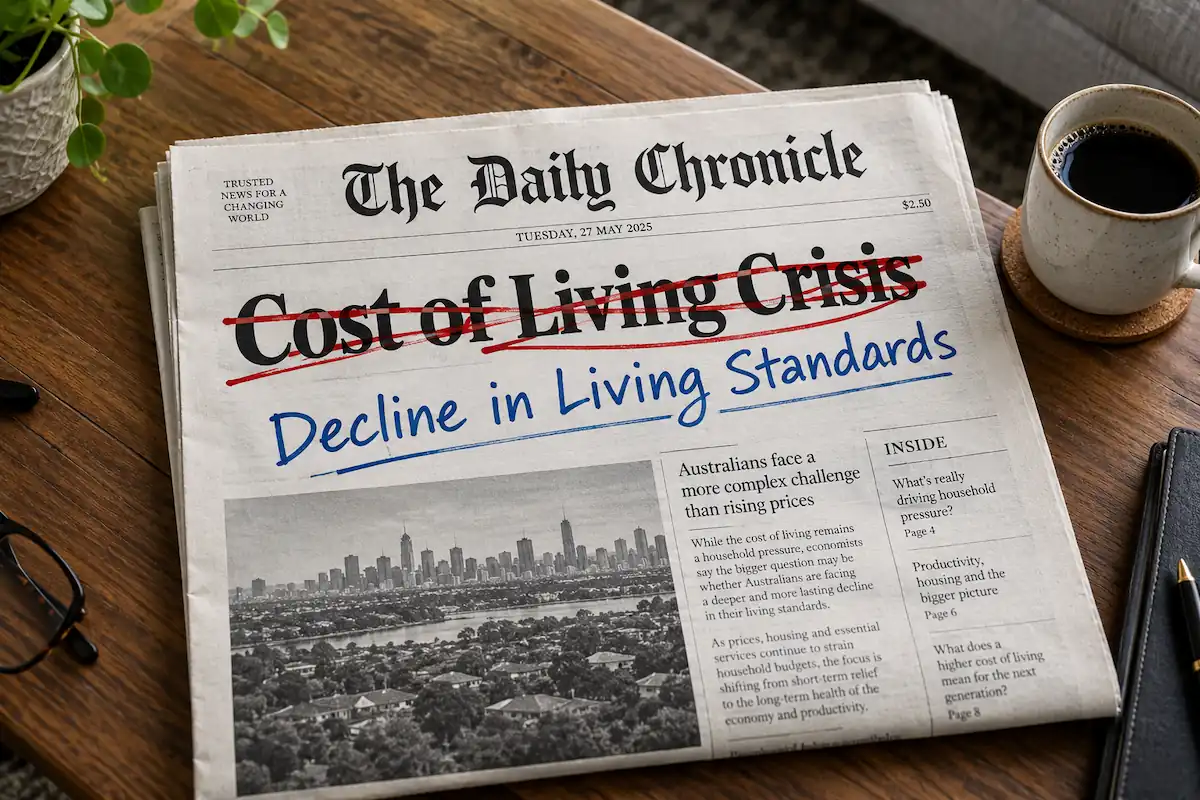
We keep being told Australia is in the middle of a cost of living crisis.
And there is no denying that life has become more expensive. Groceries cost more. Rent costs more. Petrol costs more. Buying a home has moved further out of reach for many Australians.
But perhaps we are asking the wrong question.
A cost of living crisis suggests something has happened to us. Prices have risen, times are tough, but eventually the crisis will pass and life will return to normal.
What if it doesn’t?
What if the real problem isn’t simply that things have become more expensive, but that the standard of living we have come to expect is becoming harder to afford?
That is a very different problem.
A crisis calls for relief.
A decline in living standards calls for something much harder: change.
Cost of Living Crisis – A Convenient Diagnosis
What if framing the current economic situation as a cost of living ‘crisis’ is wrong? Why would we even frame it this way in the first place?
When we hear the term ‘crisis‘ we tend to think that it is an event that is happening to us. It often relates to an unforeseen set of circumstances that was thrust upon us.
Calling it ‘a crisis’ tends to shift our attention towards what happened to us, rather than what might have been happening underneath the surface.
A ‘crisis’ suggests that it is short-term – we just have to bunker down and get through it together.
There is also a feeling that when the ‘crisis’ is over, things will go back to normal, that prices will all somehow become more affordable again.
The language of “cost of living crisis” may be obscuring the more important questions about living standards. It allows us to ‘standby’, waiting for help that may never come, rather than dealing with the core issues that need to be solved.
A Price Problem or a Prosperity Problem?
Living standards aren’t simply reliant on whether prices are stable or rising. It is tight relationship between;
what we produce → what we earn → what we can consume → what we can save
A household can tolerate inflation without experiencing a permanent decline in living standards if incomes and productivity rise sufficiently.
Conversely, prices could stabilise while living standards continue deteriorating if:
- wages stagnate
- housing absorbs more income
- taxes increase
- productivity falls
- essential services become more expensive
- working hours increase to maintain the same lifestyle
If inflation returned to 2% tomorrow, would Australians suddenly be able to afford the lifestyle they had five years ago?
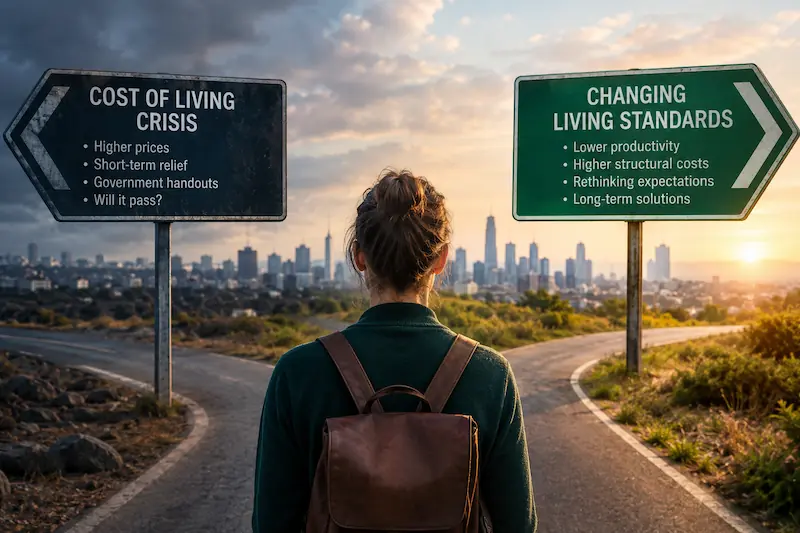
When Yesterday’s Lifestyle Becomes Unaffordable
What if there is a bigger problem here – what if living standards are really falling?
In framing the current environment as a ‘cost of living crisis’ it is easy to focus on all the external issues that may be the cause. We hear about the war in Ukraine, or Iran, or the US tariffs, or any other number of external reasons for rising prices.
But what if we are also dealing with key structural problems closer to home?
We have a number of factors that may be the underlying cause for the falling standards of living, such as;
Weak productivity growth – if we produce less per hour, it becomes harder for wages and living standards to keep rising.
Aging population – fewer workers supporting more retirees puts pressure on both the economy and government finances.
Higher Energy costs – expensive energy raises the cost of producing almost everything.
Higher government debt – higher interest payments for the government becomes money that can’t be spent on public services.
Institutionalised Red-tape – the cost of building or producing anything is significantly increased by poor process and choking regulations.
The issue is these aren’t problems that can be fixed with a rebate or a one-off payment. They took years to develop, and they will take years to address.
That makes this look less like a crisis we simply need to get through, and more like a structural change we need to face.
What if the lifestyle we’ve come to regard as “normal” is no longer economically sustainable?
You Can’t Subsidise Your Way to Prosperity
When we have a crisis we all expect the government will step in and fix things. And of course there will be a typical response of energy relief, rent assistance, cheap childcare and other rebates and subsidies.
But while these things may be popular with the voters, are they addressing the real issue?
Relief can help people survive a problem. But it doesn’t necessarily solve the problem.
A $500 payment might make a household’s month easier.
- It doesn’t make the economy more productive.
- It doesn’t create more housing.
- It doesn’t increase real wages.
Relief can help people survive a problem. But it doesn’t necessarily solve it.
None of this is to suggest that households aren’t genuinely struggling, or that government has no role in helping people through difficult periods. For many families, rising costs are a very real problem.
The question is whether temporary relief should be confused with a solution to a much deeper problem.
Are we solving the problem—or simply making the symptoms less painful?
What If We Can’t Afford Our Expectations?
Consider what we now regard as a normal standard of living:
- Owning a (large) home
- Two cars (more if you have kids)
- An overseas holidays every year
- Regular dining out
- Multiple entertainment/streaming services
- Early retirement – on the same living standards as when working
- Constant technological upgrades
- High levels of consumption
Maybe this isn’t just about inflation. Maybe it’s about what we have come to expect from life.
The question isn’t whether people deserve these things – it’s whether an economy can continue delivering them.
What if the next generation isn’t entitled to a higher standard of living than the previous generation—and what happens when we refuse to accept that possibility?
Maybe We Need a Different Conversation
There is a main stream narrative that people are struggling because the cost of living has exploded. Therefore the government needs to do more to help households.
But really people are struggling because the economic conditions that produced their expected standard of living have changed. Governments can provide some relief, but it cannot simply legislate prosperity back into existence.
If this really is a decline in living standards rather than merely a cost-of-living crisis, then the conversation needs to change.
We need to be talking about productivity, government spending and debt, and importantly incentives to kick start the economic engine again.
And perhaps most uncomfortably, we need to talk about what we’re willing to give up.
We need to change the conversation from ‘how do we get through this?’ to, ‘what needs to change because the old circumstances may not be coming back?’
Leave a Reply