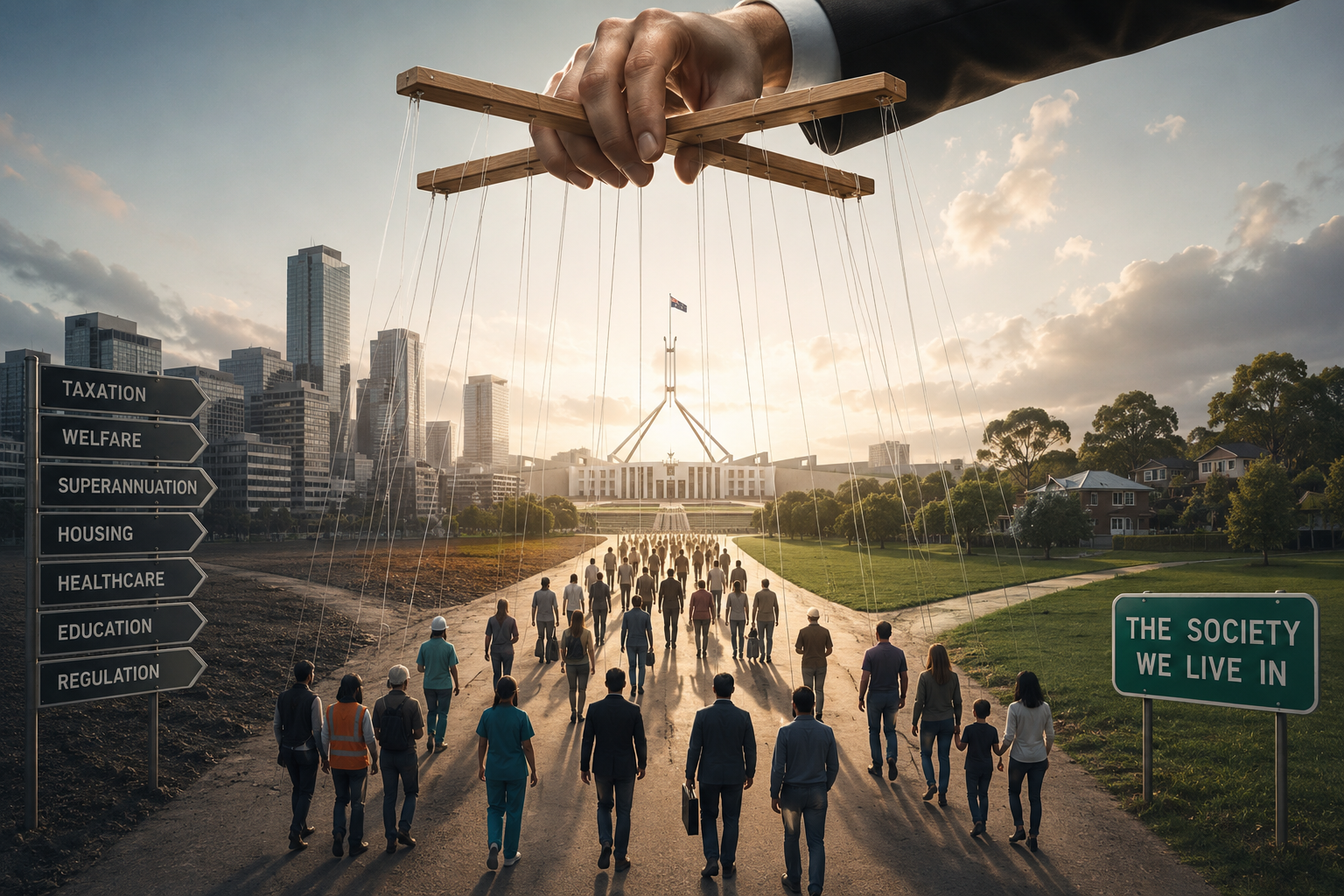
How Labor’s philosophy on equality, taxation, retirement and inheritance is reshaping Australian society
Most Australians can tell you which government policies they support;
- Housing affordability.
- Tax cuts.
- Medicare.
- Childcare.
But policies only address symptoms. They are an insight into a political philosophy designed to change society.
Most people vote for policies.
Very few people vote for philosophies.
Yet it is philosophy that ultimately shapes a nation.
Governments and our elected leaders have the ability to significantly shape our world, not just in the short term, but for generations to follow.
The Great Equalisation
In Australia we currently have a ‘left-leaning’ government, lead by the Australian Labour Party. The common theme across fifty years of Labor party platforms is remarkably consistent: society should become more equal.
- fair distribution of wealth
- fair distribution of opportunity
- reducing disadvantage
- reducing inequality
This is best summarised from as far back as the 1979 ALP Platform 33rd National Conference;
“Labor believes that political freedom is only meaningful when society is free of economic injustice, gross inequality and poverty, and when the economy serves the interests of all the community and ensures an equitable distribution of wealth, goods, services and information.”
The latest federal budget realised in May this year provides a series of insights into this philosophy. While on the surface it has the appearance of being one striving for more ‘equality’, there are even deeper goals at play…
The Hidden Social Contract
If equality is the goal, what kind of society naturally emerges?
A society focused on equality does not merely need to lift people from the bottom – it must also place limits on how far people can move ahead.
This is where many modern policy debates suddenly begin to make sense.
- Superannuation
- Housing
- Inheritance
- Taxation
- Retirement
Viewed individually they seem like unrelated policy discussions. Viewed together they reveal a much bigger picture.
The cumulative effect begins to create a new social contract.
The government will provide a framework where everyone is taken care of, however the citizens must agree to pay for it.
Simple enough…but there’s a catch…
More Tax Please…
Running this form of society is expensive. Really expensive.
- Healthcare
- Education
- Aged care
- The NDIS
- Housing assistance
- Income support
Every year the bills grow larger. And every year somebody has to pay for it.
One of the uncomfortable truths of modern politics is that every dollar redistributed by government must first be created by somebody else.
The welfare state ultimately depends on the very wealth creators it often criticises.
Tax them too lightly and inequality grows. Tax them too heavily and wealth creation slows.
The entire system exists within that tension.
As government spending grows, so does the need for revenue. And that revenue increasingly comes from those who have accumulated wealth, assets or higher incomes.
The pursuit of equality inevitably becomes linked to the pursuit of taxation.
The welfare state ultimately depends on the very people it is trying to restrain.
Why Retirement Becomes an Issue
The government receives over half of it’s revenue from personal income tax, and according to the latest budget this will continue to grow. While this dependance increases, having people employed is increasingly important, to keep the social machine funded.
What happens if too many people become financially independent and leave the workforce early?
From an individual’s perspective, retiring at 50 may be a success story. From the government’s perspective, it is the loss of a taxpayer – often a very large taxpayer.
The people who retire early are often the same people who spent decades in high-income professions paying large amounts of tax. This is why governments become increasingly interested in retirement ages, superannuation access, and wealth accumulation.
Measures must be taken to slow down the ability to build too much wealth and retire early.
How Much is “Enough”?
Every economic system eventually arrives at the same question.
How much is enough?
Australia has an amazing Superannuation system.
Someone entering the workforce today and doing little more than turning up to work consistently could retire in forty-five years with around $4 million in superannuation, or roughly $1 million in today’s dollars.
That is a remarkable achievement. But it also reveals something interesting.
The purpose of superannuation was never to create generational wealth. Its purpose was to provide security in retirement.
This distinction matters.
Because once government begins deciding what constitutes an adequate retirement, it inevitably begins deciding what constitutes excessive retirement wealth.
The recent tax changes around larger superannuation balances provide a glimpse into this thinking.
The underlying question remains:
Should government have a role in deciding how much wealth is enough?

No More Inheritance
Perhaps the most revealing debate of all is inheritance.
Most parents want to leave something behind.
A home deposit.
A financial safety net.
A better starting position than they themselves enjoyed.
That all seems perfectly natural.
But from the perspective of equality, inheritance creates a major problem. A society cannot simultaneously maximise equality while allowing large inheritances.
The more wealth that passes from one generation to the next, the more unequal the starting positions become.
Some children inherit nothing. Others inherit enough to completely alter the trajectory of their lives.
This is one of the uncomfortable truths hiding beneath modern political debates. The more serious a government becomes about reducing inequality, the more interested it becomes in inherited wealth.
This is why trusts, superannuation balances, estate planning and intergenerational wealth transfer attract increasing political attention.
Not simply because they represent tax revenue – although I’m sure that doesn’t hurt the internal government debate…
But because they represent accumulated advantage.
The modern trend appears to be moving towards a world where people work until retirement age, retire on a comfortable but modest nest egg, spend most of that money during retirement, and leave little behind.
The rise of the ‘Die With Zero’ philosophy feels remarkably compatible with that vision.
Some form of inheritance tax is increasingly likely, given the level of intergenerational wealth transfer that is about to happen. It is way too big a honey pot to be ignored by government.
When Wealth Itself Becomes the Problem
This is perhaps the most uncomfortable implication of all.
A government focused on poverty wants people to have enough. A government focused on inequality must eventually concern itself with how much people have.
At that point, wealth itself becomes a policy issue.
Not poverty. Not hardship. Wealth.
The current policy direction increasingly appears to favour a narrower distribution of wealth across society.
Not equal outcomes. But smaller gaps between outcomes.
The question is whether this causes unintended consequences.
The Undesired Consequences
The challenge with any philosophy is that its biggest strengths often become its greatest weaknesses.
The desire to reduce inequality sounds admirable. Few people would argue against a fairer more equitable society.
But what happens when equality becomes the primary objective? What traps do we fall into when provide more for some, and take away more from others?
Decreased Aspiration
What happens when people stop asking:
“How can I get ahead?”
And start asking:
“How much will be taken if I do?”
A society still needs people willing to take risks, build businesses, invest capital and create wealth.
Without aspiration, there is, ironically, less wealth available to redistribute in the first place.
Increased Dependency
“What if I simply sit back and allow the system to care of me? Where is my incentive to do more to get ahead?”
As public services expand:
- citizens rely more on government,
- government spending rises, and therefore
- taxation rises!
A vicious cycle is created.
The more support that is provided, the more funding is required. The more funding that is required, the greater the pressure to tax.
Intergenerational Assistance or Welfare?
Perhaps the most personal question is this…
Should families be allowed to significantly improve the position of their children?
Or should each generation be made to largely start from scratch?
Should any government be allowed to make this decision on our behalf?
These are not simply tax questions. They are questions about what type of society we want to build.
What is the Ultimately Role of Government?
Perhaps Labor’s vision is correct. Perhaps a society with smaller wealth gaps, stronger safety nets and less inherited advantage is ultimately fairer.
But Australians should understand the destination before they choose the journey.
Because beneath debates about superannuation, housing, taxation and welfare lies a much bigger question:
Should the role of government be to help people get ahead?
Or to make sure nobody gets too far ahead?
Because those two goals sound remarkably similar at first glance.
Yet they lead to very different societies.

Leave a Reply