
Imagine telling someone in 1980 that one day an ordinary Australian family would expect two cars, a large house, overseas holidays, multiple televisions, a smartphone in every pocket, streaming entertainment, and the ability to retire decades before they die.
They might have thought we’d all become unimaginably wealthy.
Yet here we are – and somehow we are still feeling poorer, struggling to make ends meet.
So what happened?
Perhaps the answer isn’t simply that life became more expensive.
Perhaps our definition of a normal life simply became more expensive.
What Happened to Normal?
When did two cars become normal for a family?
When did an annual overseas holiday become an expectation rather than a luxury?
How much of what we call “necessities” would previous generations have considered luxuries?
For many of us, 1980 feels like yesterday, and yet in this relatively short period our expectations of living standards have exploded.
Have we forgotten just how much we’ve come to expect?
Are we measuring our lifestyle against what humans need—or what modern society tells us we should have?
Perhaps the modern definition of “financial stress” includes things previous generations never even expected to have.
When More Became Normal
A home is no longer simply a roof over your head. It increasingly represents something more based on size, location, number of rooms, bathrooms, and dedicated entertainment spaces. And more recently it means investment and capital growth.
One second-hand family car becomes two, then bigger, then newer – updated every few years.
A simple phone becomes a hand-held computer, bringing the world to the palm of your hand.
The holiday an hour down the coast becomes an overseas holiday every year – then multiple times a year.
Retirement shifted from something late in life to a goal achieved early.
We didn’t just become wealthier. We became accustomed to becoming wealthier.
When laid out they show us how our expectations of ‘life’ has changed so much in a few short years.
At what point does a higher standard of living stop being genuine progress and become an expectation the economy may struggle to deliver?
The Richest People in History Still Feel Poor
By many measures, Australians enjoy a material standard of living that previous generations could scarcely have imagined – and yet many of us still feel like we are somehow ‘struggling’.
Perhaps the issue is that we no longer compare our lives to those closest to us, but with the world.
Instagram, TikTok and other platforms turn other people’s lifestyles into a continuous stream of evidence that we may not be doing so well after all.
And importantly, we’re usually comparing our ordinary life with somebody else’s highlight reel – and often a reel that isn’t real!
No matter how relatively wealthy we may be, we are being exposed to people who always appear richer. Our reference point for a ‘normal’ life is now focused on the top 10%, or worse, lifestyles that may not even exist.
What if some of our dissatisfaction is being manufactured by comparison rather than caused by actual deprivation?
The Generational Promise
For much of the post-war period, there was a powerful social expectation: your children would live better than you did.
This is the deal we thought we had and that expectation became part of the social contract.
But what happens if the next generation isn’t materially better off?
Perhaps the problem is partly because we have built expectations of living standards that require consistently increasing productivity. However, that productivity has been slowing for years and recently has even dipped into negative territory.
The Productivity Commission explicitly links Australia’s weak productivity performance with stagnant living standards and income growth. This is an uncomfortable truth for a country to come to terms with, rather than just blaming things like inflation.
Perhaps the real shock isn’t becoming poorer – it’s discovering that becoming richer was never guaranteed.
Our increase in living standards didn’t happen by accident. It came from hard work, investment, innovation and an ongoing drive to create a better lifestyle. It was never guaranteed – it was something we had to work for.
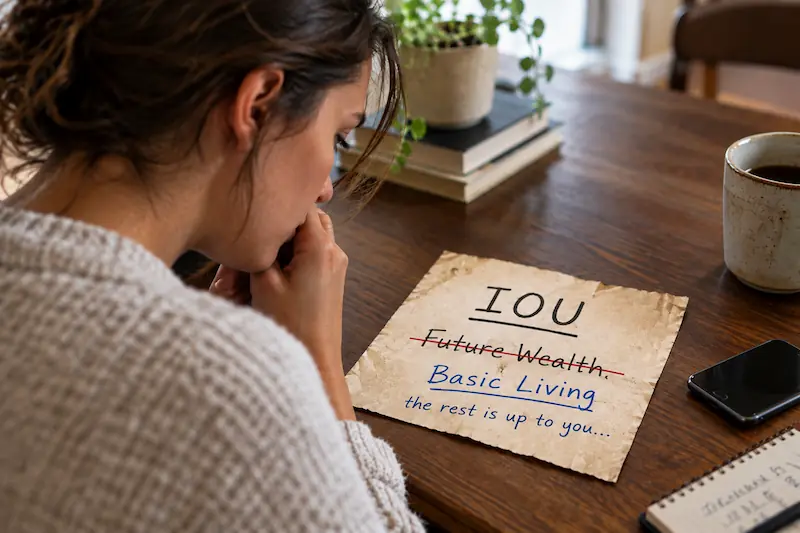
What If We Can’t Afford the Life We’ve Come to Expect?
Imagine if the next decade doesn’t deliver the economic growth of the previous decades. How might that affect our lives?
Will we need to work longer, live in smaller, more modest houses, travel less, retire later or simply consume less?
Perhaps we’re already seeing a glimpse of this future—but we’re calling it a cost-of-living crisis rather than asking whether something more fundamental is changing for the long term.
We can keep demanding that the government finds someone to pay for the gap between the economy and our living expectations— but who will that someone be?
What if that someone turns out to be us?
What if maintaining our current standard of living requires us to give something up?
We’ve built expectations of consumption that require continually increasing productivity and income—and now we’re discovering what happens when that growth slows.
The Social Cost of Disappointment
Unfortunately, there is a much bigger social problem if these challenges are not addressed— by both our government and by us.
When rising living standards become an expectation rather than an achievement, falling behind doesn’t simply feel like having less. It feels like something has been taken away.
If expectations continue to rise while economic capacity doesn’t, people will respond in a number of ways:
- working longer – multiple jobs
- taking on more debt
- delaying children
- delaying or giving up on home ownership
- relying more heavily on government
And this starts affecting social cohesion. We become resentful of people who appear to have ‘more’.
Because when people wake up to the truth that the system can no longer deliver the lifestyle they were ‘promised’, somebody eventually gets the blame.
The rich, the landlords…
The government, or perhaps immigrants…
Older generations, or young people…
Corporations, employers…
And that’s where an economic problem can become a political and social problem. Political movements will inevitably emerge offering someone to blame—and an empty promise that the old lifestyle can be restored.
What If “Better” Is No Longer Automatic?
In a previous essay, we asked the question: what if there isn’t a cost of living crisis? And if we are really experiencing a shift in living standards, what does that really mean?
If the economy has changed, and there is real evidence that this is the case, then we need to come to terms with our new reality. Expecting that the government will somehow plug the gap is setting the scene for longer-term pain.
We need to distinguish between a standard of living we genuinely need and a standard of living we have simply become accustomed to expecting.
Perhaps the next generation’s challenge isn’t figuring out how to afford everything we’ve come to expect— but instead deciding which things actually matter?

Leave a Reply