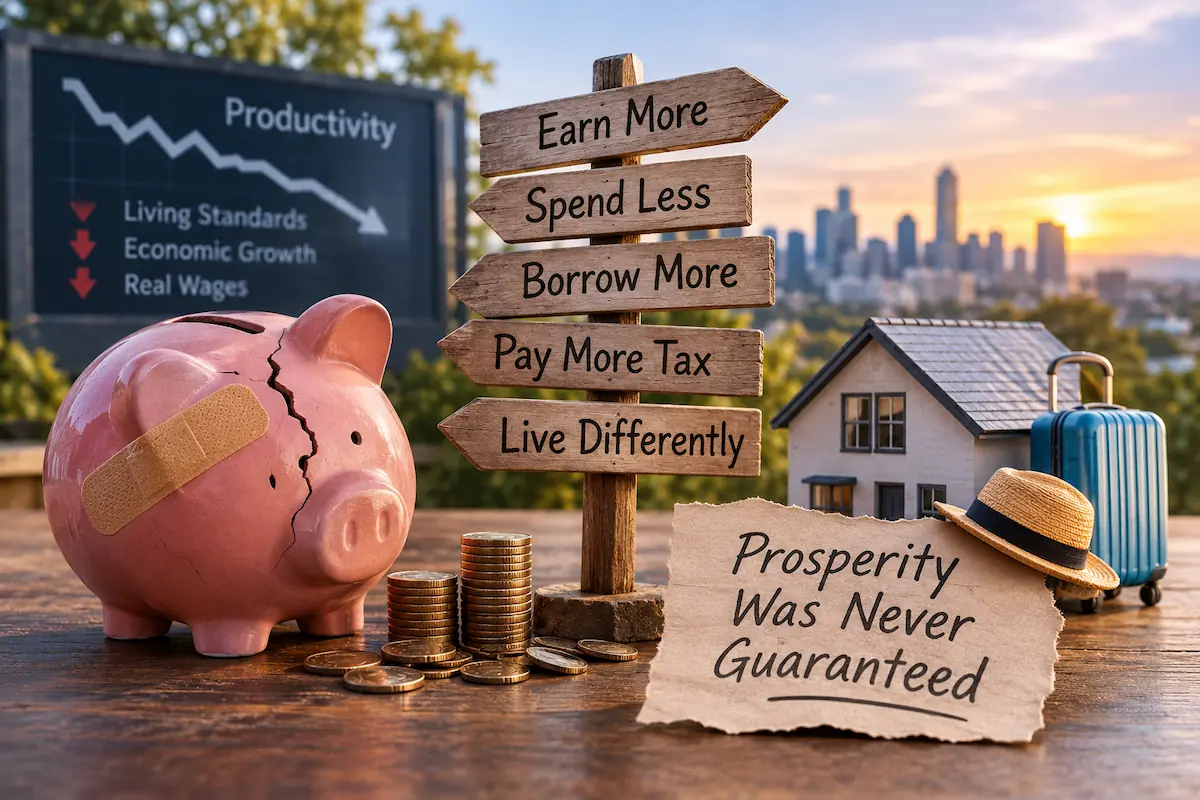
Someone Always Has to Pay
Imagine a family discovering that their income has stopped growing, but they still expect the bigger house, two cars, overseas holidays, early retirement, and everything else they’ve come to regard as normal.
There are only a few options:
Earn more.
Spend less.
Borrow more.
Or find someone else to pay.
Why should we look at the country’s economy any differently?
For years, we’ve become accustomed to a standard of living that seemed to improve almost automatically. When that stopped happening, we called it a cost-of-living crisis and looked to government to help us maintain it.
But what if the problem runs much deeper? What if the economy can no longer generate the prosperity needed to sustain the lifestyle we’ve come to expect?
And if that’s the case, who is responsible for making up the difference?
The Government Can’t Print Prosperity
It has become very clear that the cost-of-living crisis is really a longer-term decline in our standard of living. And while the government may try to plug the holes, it is even more concerning that the current economy simply cannot sustain the lifestyle we have become used to.
Governments can redistribute existing wealth, which is often the first lever pulled when times are tough. They can provide tax relief, increase benefits through additional borrowing, or transfer resources from one group to another, sometimes at the expense of future generations.
But a core understanding is often lost…
Relief can make some people better off today, but it does not make our society more prosperous tomorrow.
A government can’t simply legislate higher living standards. Assistance can ease the pressure, but it cannot substitute for sustained economic growth.
Relief can make us feel richer today. Only prosperity can make us richer tomorrow.
So Where Does Prosperity Come From?
Productivity is actually the engine room behind our lifestyle. If we want to maintain our lifestyle, then we need to improve our productivity.
Now let’s be clear, that does not mean we need to work harder or longer (although that would work too).
The Productivity Commission makes this point particularly well:
Productivity growth has historically allowed Australians to earn more while working fewer hours and has been a major driver of living-standard improvements.
Productivity is simply about getting more value from the resources we already have. Producing more, or producing better, without necessarily working longer or harder.
Technology, better infrastructure, improved management, competition, education, innovation and entrepreneurship all contribute to a more productive economy.
This requires an economic and political environment that rewards capital investment.
What if the real cost-of-living problem isn’t that everything is getting more expensive, but that we’re getting no better at producing the things we need?
The Productivity Problem
Australia has a genuine productivity problem. The Productivity Commission’s September 2026 data shows whole-economy labour productivity fell 0.2% over the year to June 2026, while its five-year average was -0.5%.
Productivity determines how much economic capacity we have to support wage growth, healthcare, pensions, infrastructure and the services we have come to expect.
What happens when our expectations continue rising but the economy’s ability to produce more doesn’t?
A society can try and redistribute a pie indefinitely, but it cannot keep increasing everyone’s share if the pie isn’t growing.
The Politics of Pretending
The mainstream political conversation tends to ask:
What can the government do to make life more affordable?
Really we should be asking:
What can the government do to make Australia more productive?
While these two things sound similar, they are actually very different – both in the results and how they are ‘sold’ to the public.
Saying, “Here is $x in cost-of-living assistance” is tangible.
But “Here is a 10-year productivity reform agenda” is difficult to sell.
The current government recognised that both needed to be addressed in its 2026 budget release. They even acknowledge that productivity is necessary to lift wages and living standards, however the emphasis remains on cost-of-living relief.
Every government faces pressure to solve today’s pain rather than undertake reforms whose benefits may not arrive for years. In good times, productivity is easily overlooked. In bad times, the focus shifts to immediate relief.
And so the difficult work gets pushed further down the road.
The Part Nobody Wants to Hear
So here we are clinging to a standard of living that looks precarious, and expecting the government to plug the gaps. Meanwhile, the productivity that supports that demand has stalled.
Governments cannot indefinitely borrow to maintain a standard of living that the economy is no longer generating. At some point, the bill comes due.

What if the solution isn’t finding enough money to preserve everything we’ve come to expect?
What if we actually have to make some difficult choices…
- Work longer and retire later.
- Live in smaller homes and consume less.
- Accept fewer government services.
- Pay more tax.
- Invest more for tomorrow and consume less today.
None of these sound attractive.
That’s precisely why the conversation rarely gets this far. Because it forces us to face a really uncomfortable question…
Have we become so accustomed to our standard of living that we’re prepared to make someone else pay to preserve it?
Younger generations, future taxpayers, investors, higher-income earners, those relying on government services, or perhaps simply all of us.
Perhaps the problem isn’t that we can no longer afford the lifestyle we want, but that we’ve forgotten what it takes to create it.
Perhaps the bigger problem is that we’ve become very good at expecting prosperity, but less willing to consider what it takes to create it. We expect higher wages, cheaper goods, better services and more government support, but rarely stop to ask where the additional wealth to fund these expectations is supposed to come from.
Somewhere along the way, we’ve become more focused on protecting our share of prosperity than creating more of it.
What If More Isn’t the Answer?
Perhaps we need to shift the conversation from ‘how do we all become richer’ and ask ‘what is prosperity actually for?’.
If productivity allows us to produce more, what should we actually do with that productivity?
More stuff? Bigger houses? More consumption simply feeding the corporate machine?
Perhaps the increase in productivity should focus on:
- More leisure and family time.
- Earlier retirement.
- Better health.
- Stronger community connection.
- Greater financial resilience.
- And importantly, less environmental pressure.
One of the biggest turning points in our own wealth creation came when my wife and I realised we could live with less – much less. When we stopped chasing the ‘stuff’ and escaped the consumption trap, our true wealth began to grow. Not necessarily because we earned more, but because we needed less.
Perhaps productivity is better measured by how much it enriches our lives, rather than simply how much more it allows us to consume.
We Have to Create the Future
We have spent years desperately trying to preserve the lifestyle we’ve inherited.
So when this current downturn in living standards hit, we called it a ‘cost of living crisis’ – something temporary that will be fixed. When it dragged on a little longer than expected, we turned to the government to fix the issues, then to somehow supplement our living standards.
Perhaps now the reality is sinking in that this is a long-term issue, that cannot be solved by government ‘hand-outs’. This is now something that we all need to take responsibility for – especially the creation of the future we want.
Prosperity and our living standards were never guaranteed. There have been hard times in the past, and to think that we were somehow immune from them was misguided.
But there will be good times again. The question is whether we’re prepared to make the changes necessary to create them.
Perhaps the greatest mistake we’ve made is assuming that prosperity is something we’re entitled to inherit, rather than something every generation has a responsibility to create.
We seem to have become very good at expecting a better life. Perhaps it’s time we started thinking about what it takes to build one.

Leave a Reply