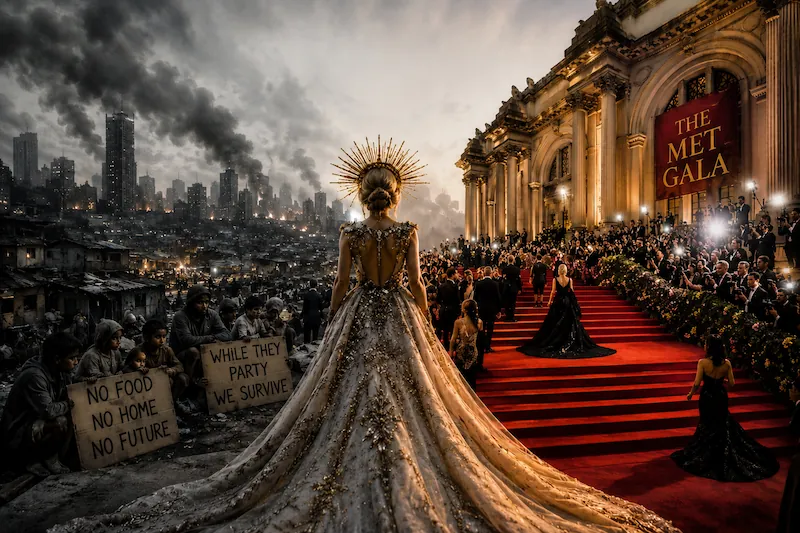
What does it mean when fiction is overtaken by reality?
And how disturbing is it when that fiction was originally written as a warning?
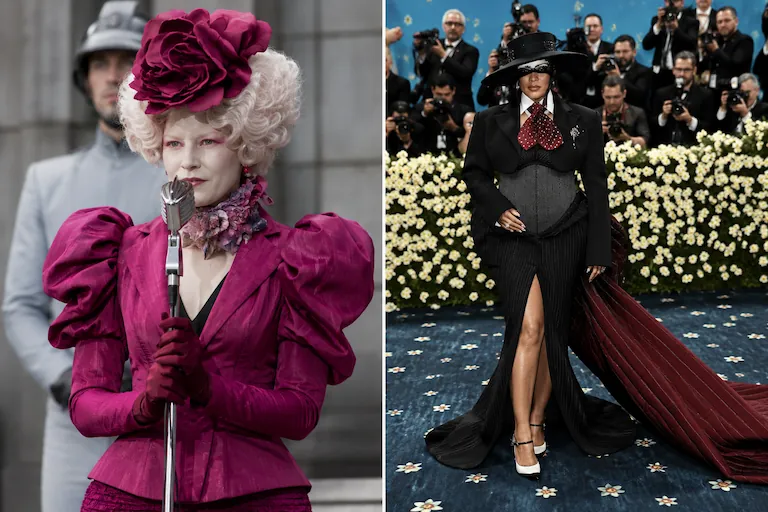
I had this thought while watching this year’s Met Gala unfold across social media. As celebrities drifted across the red carpet in increasingly theatrical costumes, I immediately thought of The Hunger Games.
The Capitol was supposed to feel absurd and make us feel uncomfortable. Instead, it somehow felt familiar.
How can such theatrics and excess even exist while there are people struggling to feed their family?
Modern society no longer asks whether something is meaningful — only whether it is visible.
And few events capture that better than the Met Gala.
The Hunger Games was meant to be Fiction
The Hunger Games is a novel by Suzanne Collins, and later made into a movie. It tells of a fractured society, where a select few live a life of luxury and excess while the bulk of the population endure unreasonable conditions to provide the resources.
While this style of dystopian stories are incredibly entertaining, they also provide a warning of how things could evolve if we are not vigilant and careful. It is easy to dismiss such claims – until you witness events like The Met Gala.
The Spectacle Economy
The Met Gala began in 1948 as a modest fundraising dinner for the Costume Institute at the Metropolitan Museum of Art. Tickets reportedly cost just US$50.
Today, tickets exceed US$100,000 and tables can cost more than US$350,000.
Somewhere between those two numbers, the event stopped being a fundraiser and became a spectacle.
Officially, the event raises money for the museum’s fashion and costume department. On paper, that sounds entirely reasonable. Arts funding matters. Cultural preservation matters.
But at what point does fundraising stop being philanthropy and become theatre?
The event reportedly raised more than US$42 million this year with only around 450 attendees. While this is impressive it is difficult to reconcile such an extravagant performance in a world where millions struggle with housing, food insecurity, debt, and isolation.
How is it that society can mobilise tens of millions of dollars so effortlessly for fashion spectacle, while basic human suffering constantly fights for attention?
That contradiction is difficult to ignore.
The New Aristocracy
What makes the Met Gala particularly fascinating is not simply the money — it is the exclusivity.
You cannot simply buy a ticket online. Even wealth is not enough.
Attendance reportedly requires approval from the organiser, Anna Wintour herself. Guests must possess “industry relevance” or some form of celebrity or cultural status. Most attendees are sponsored by luxury brands who purchase entire tables and invite carefully selected celebrities to represent them.
The whole event functions as a perfectly engineered status machine.
Scarcity creates mystique.
Mystique creates attention.
Attention creates cultural power.
And cultural power creates profit.
The Met Gala may be one of the most successful marketing machines ever created – engineer exclusivity and scarcity and the masses will tune in.
But it also reveals something deeper about modern culture. Increasingly, society rewards people not for contribution, wisdom, or usefulness — but for visibility.
The people receiving the greatest cultural attention are often not the people building society, holding communities together, teaching children, caring for the vulnerable, or solving difficult problems.
They are simply the people being watched.
It deliberately segregates and separates people into those who are somehow worthy of attention and those who are not.
Spectacle Cannot Exist Without Spectators
It would be easy to dismiss the Met Gala as simply another example of rich people becoming disconnected from reality.
But perhaps the harsher truth is that they understand society perfectly.
They understand that modern culture runs on attention.
The more excessive the outfit, the more outrageous the behaviour, the more bizarre the performance — the more people will watch, share, repost, and discuss it.
Every second of attention becomes profit for somebody.
That is why the real issue is not the Met Gala itself.
The real issue is that millions of ordinary people willingly participate in the spectacle economy every day. We claim to dislike superficial culture while consuming endless amounts of it voluntarily.
We promote this behaviour by the level we invest our lives into social media. The hours of doom scrolling, focusing on the outrageous and hideous just feeds the beast.
Spectacle cannot exist without spectators.
If nobody watched the Met Gala, it would disappear almost overnight.
Which means the audience is not separate from the machine.
We are part of it.
Modern society increasingly rewards people for being watched rather than being useful
The Capitol Closer to Home
The uncomfortable reality is that the forces driving the Met Gala are not confined to celebrities and luxury brands. They increasingly shape everyday life as well.
In the workplace, the employee who publicly performs often advances faster than the quiet worker who creates genuine value behind the scenes.
Perception increasingly outweighs contribution.
At home, many people feel financially trapped while simultaneously financing lifestyles designed to appear successful. Expensive holidays, designer products, luxury cars, constantly upgraded phones — not because they meaningfully improve life, but because modern culture pressures people to project success outwardly.
We are increasingly buying social camouflage rather than genuine fulfilment.
Even relationships are not immune. Social media encourages people to present idealised versions of their lives while privately struggling with loneliness, resentment, and disconnection.
The performance becomes more important than the reality.
The image becomes more important than the substance.
And slowly, almost without noticing, society begins rewarding appearance over meaning in every corner of life.
What Does a Society Worship?
Dystopian stories like The Hunger Games are not written simply to entertain us. They are warnings about what happens when societies drift too far toward inequality, spectacle, distraction, and emotional detachment.
The disturbing thing about the Met Gala is not merely the extravagance. It is how normal it now feels.
Perhaps the most insidious thing about the Met Gala is that it promotes insecurity disguised as inspiration. The more insecure, and ‘less than’ we feel in our lives, the more we will strive to become one of the ‘chosen’.
A civilisation reveals what it worships by what it celebrates. And modern society increasingly celebrates visibility, performance, status, and attention above almost everything else.
Perhaps that is the real warning hidden beneath the spectacle.
Not that the Capitol exists – But that millions of people have slowly learned to admire it.
Leave a Reply